

How To Draw Hydrogen Bonding
Hydrogen Bonding
- Folio ID
- 1230
The most powerful intermolecular force influencing neutral (uncharged) molecules is the hydrogen bail. If we compare the boiling points of methane (CH4) -161ºC, ammonia (NHiii) -33ºC, water (H2O) 100ºC and hydrogen fluoride (HF) 19ºC, nosotros run across a greater variation for these similar sized molecules than expected from the data presented above for polar compounds. This is shown graphically in the post-obit chart. Nearly of the simple hydrides of group Iv, 5, Vi & VII elements display the expected ascension in humid point with molecular mass, but the hydrides of the well-nigh electronegative elements (nitrogen, oxygen and fluorine) have abnormally high humid points for their mass.
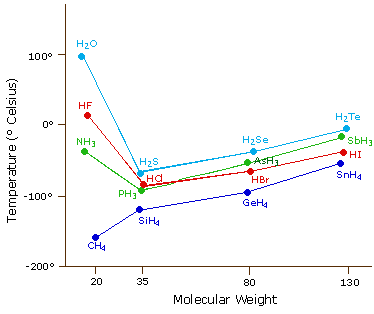
The exceptionally stiff dipole-dipole attractions that cause this behavior are chosen the hydrogen bond. Hydrogen forms polar covalent bonds to more electronegative atoms such every bit oxygen, and because a hydrogen atom is quite small-scale, the positive end of the bond dipole (the hydrogen) can approach neighboring nucleophilic or basic sites more closely than tin other polar bonds. Coulombic forces are inversely proportional to the sixth ability of the distance between dipoles, making these interactions relatively strong, although they are however weak (ca. iv to 5 kcal per mole) compared with nigh covalent bonds. The unique backdrop of h2o are largely due to the potent hydrogen bonding that occurs between its molecules. In the following diagram the hydrogen bonds are depicted as magenta dashed lines.
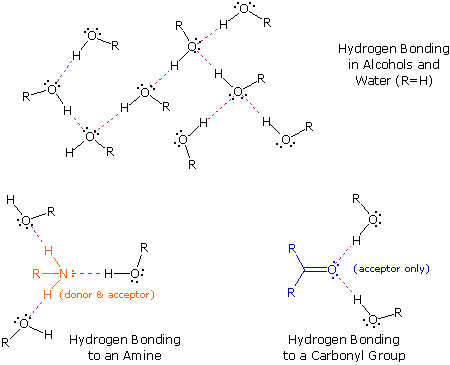
The molecule providing a polar hydrogen for a hydrogen bond is chosen a donor. The molecule that provides the electron rich site to which the hydrogen is attracted is chosen an acceptor. H2o and alcohols may serve equally both donors and acceptors, whereas ethers, aldehydes, ketones and esters can function only as acceptors. Similarly, primary and secondary amines are both donors and acceptors, but tertiary amines function just as acceptors. Once y'all are able to recognize compounds that can exhibit intermolecular hydrogen bonding, the relatively high humid points they showroom become understandable. The data in the following table serve to illustrate this point.
| Chemical compound | Formula | Mol. Wt. | Humid Signal | Melting Indicate |
|---|---|---|---|---|
| dimethyl ether | CH3OCHiii | 46 | –24ºC | –138ºC |
| ethanol | CH3CH2OH | 46 | 78ºC | –130ºC |
| propanol | CH3(CH2)2OH | 60 | 98ºC | –127ºC |
| diethyl ether | (CH3CHtwo)2O | 74 | 34ºC | –116ºC |
| propyl amine | CH3(CHii)2NH2 | 59 | 48ºC | –83ºC |
| methylaminoethane | CH3CHtwoNHCH3 | 59 | 37ºC | |
| trimethylamine | (CH3)iiiN | 59 | 3ºC | –117ºC |
| ethylene glycol | HOCH2CH2OH | 62 | 197ºC | –13ºC |
| acetic acrid | CHiiiCOtwoH | sixty | 118ºC | 17ºC |
| ethylene diamine | H2NCH2CH2NHtwo | 60 | 118ºC | 8.5ºC |
Alcohols boil cosiderably college than comparably sized ethers (first two entries), and isomeric 1º, 2º & 3º-amines, respectively, show decreasing boiling points, with the two hydrogen bonding isomers being substantially higher boiling than the 3º-amine (entries 5 to vii). As well, O–H---O hydrogen bonds are clearly stronger than N–H---N hydrogen bonds, as nosotros see past comparing propanol with the amines.
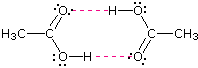
As expected, the presence of 2 hydrogen bonding functions in a compound raises the boiling signal fifty-fifty further. Acerb acid (the ninth entry) is an interesting instance. A dimeric species, shown on the right, held together past two hydrogen bonds is a major component of the liquid state. If this is an authentic representation of the composition of this chemical compound then we would expect its boiling bespeak to be equivalent to that of a CfourH8Oiv compound (formula weight = 120). A suitable approximation of such a chemical compound is establish in tetramethoxymethane, (CH3O)ivC, which is actually a bit larger (formula weight = 136) and has a boiling betoken of 114ºC. Thus, the dimeric hydrogen bonded structure appears to exist a good representation of acetic acid in the condensed state.
A related principle is worth noting at this point. Although the hydrogen bond is relatively weak (ca. 4 to 5 kcal per mole), when several such bonds exist the resulting structure can be quite robust. The hydrogen bonds between cellulose fibers confer great strength to wood and related materials. For additional information on this subject Click Here.

How To Draw Hydrogen Bonding,
Source: https://chem.libretexts.org/Bookshelves/Organic_Chemistry/Supplemental_Modules_%28Organic_Chemistry%29/Fundamentals/Intermolecular_Forces/Hydrogen_Bonding
Posted by: wolfkintil1963.blogspot.com
0 Response to "How To Draw Hydrogen Bonding"
Post a Comment