

Is Enthalpy Intensive Or Extensive
Enthalpy
The content that follows is the substance of General Chemistry Lecture 23. In this lecture we further hash out Enthalpy and introduce its calculation using Heats of Formation and Hess's Police force.
More on Enthalpy
As we defined it in the previous lecture, Enthalpy is a mensurate of the oestrus gained or lost by a system at constant pressure. It is also a state function, meaning its value is merely concerned with the current status. The change in Enthalpy is therefore determined by the starting and catastrophe amounts of heat and it does not care how the process was conducted in between these two points. We say that the value is "contained of path"
Farther Properties of Enthalpy:
1.Enthalpy is an extensive holding. The magnitude of ΔH is dependent upon the amounts of reactants consumed. Doubling the reactants, doubles the amount of enthalpy.
2.Reversing a chemical reaction results in the same magnitude of enthalpy only of the opposite sign.
3.The enthalpy change for a reaction depends upon the state of the reactants and products. The states (i.eastward. g, l, s or aq) must be specified.
Example Problem using an Enthalpy value:
CH4(g) + 2O2(thousand) -> CO2(k) + 2H2O(g) ΔH = -802 kJ
Given the above thermochemical equation for the combustion of methane, how much heat energy is released when 4.five grams of methane is burned (in a constant pressure system)?
First determine the moles of methane: 4.5 thou x 1 mole/16 g methane = 0.28125 mol CH4
Then multiply the amount of moles by the known per mole amount of Enthalpy shown: 0.28125 * -802 kJ = -225.56 kJ or -2.3e2 kJ
You may notation that the units on the Enthalpy value are simply shown as kJ and non kJ/mol in the reaction. This lack of the per mole unit is adequately common just the per mole unit of measurement is understood to exist at that place even if it is not written, somewhat like a one coefficient in a balanced chemical reaction. Looking at the reaction in a higher place you can meet that the enthalpy value for the reaction is for i mole of Methane or 2 moles of Oxygen or i mole of Carbon Dioxide etc.
Enthalpy Values
The Enthalpy values for many substances have already been determined experimentally and are readily bachelor in tables of physical constants. The values are generally taken at what is chosen "standard land". This is the most stable state of a substance at 1 atm pressure and at a specified temperature, usually 25oC and 1M concentration for all substances in solution.
The thermodynamic standard state is divers and then that different scientists can compare results
Standard Enthalpy of Reaction - ΔHo Rxn - enthalpy change under standard conditions of 1 atm and 298.15 K.
Be careful not to confuse "Standard State" with STP as these are ii different conditions.
There are many other types of Enthalpies besides:
Enthalpies of physical alter
- ΔHfus - enthalpy of fusion - corporeality of heat required to modify a solid to a liquid
- ΔHvap - enthalpy of vaporization - amount of heat required to modify a liquid into a gas
- ΔHsub - enthalpy of sublimation - estrus required to modify a solid into a gas
One Enthalpy of item use is the Enthalpy of Formation. The Standard enthalpy of formation (ΔHo F) is the heat change that results when one mole of a compound is formed from its elements (in most stable form/natural) at a pressure level of one atm. The standard enthalpy of formation of any element in its most stable course is zero.

Find that the elements in their well-nigh stable or natural elemental form have a ΔHo F of cipher while those forms that are not stable or require a process to form have a ΔHo F value.
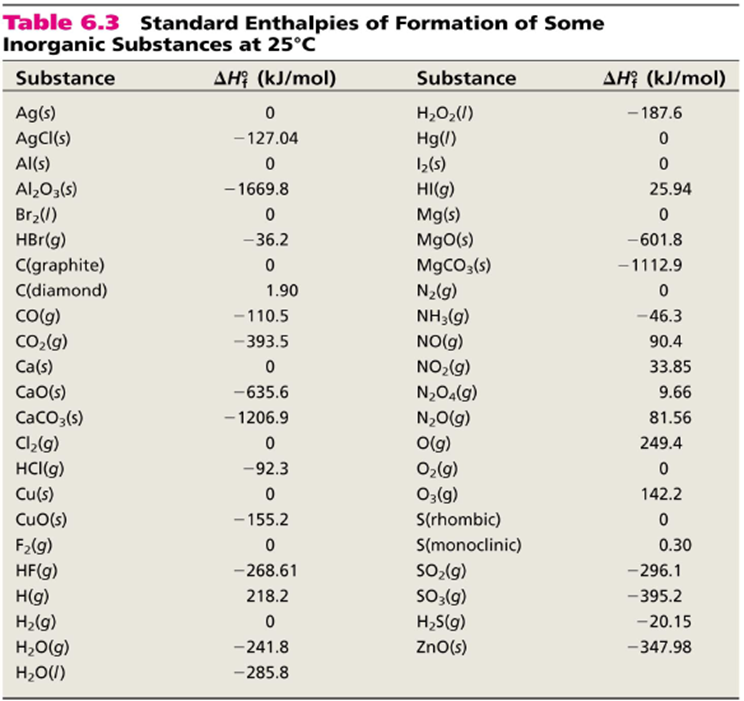
Standard Enthalpy of Reaction
The standard enthalpy of reaction (ΔHo Rxn) is the enthalpy of a reaction carried out at one atm. We have already learned ane process by which we can calculate the Enthalpy of Reaction in Calorimetry. There are two other methods we will learn at present:
1) Heat of Reaction from Standard Heats of Formation
2) Heat of Reaction from Hess' Law Calculation
Calculation of the Heat of Reaction from Standard Heats of Formation is based on the following equations:
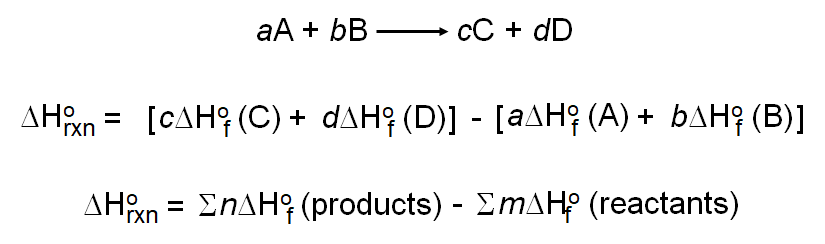
The Oestrus of Reaction tin can be calculated from the Heats of Formation of each molecule in the reaction. The equation shown above shows that the ΔHo Rxn value is calculated as the sum of the moles of the products times their ΔHo F values minus the sum of the the moles of the reactants times their ΔHo F values.
Hess'southward Law: When reactants are converted to products, the alter in enthalpy is the same whether the reaction takes place in one step or in a series of steps. Remember that Enthalpy is a state function. Information technology doesn't affair how you get there, merely where yous offset and stop.
Hither is an example of how to complete a calculation of this type:
The 3rd procedure past which you can summate the Estrus of a Reaction is by using a procedure called Hess' Constabulary. Some other way to state Hess' Constabulary is The enthalpy change of an overall process is the sum of the enthalpy changes of its private steps.
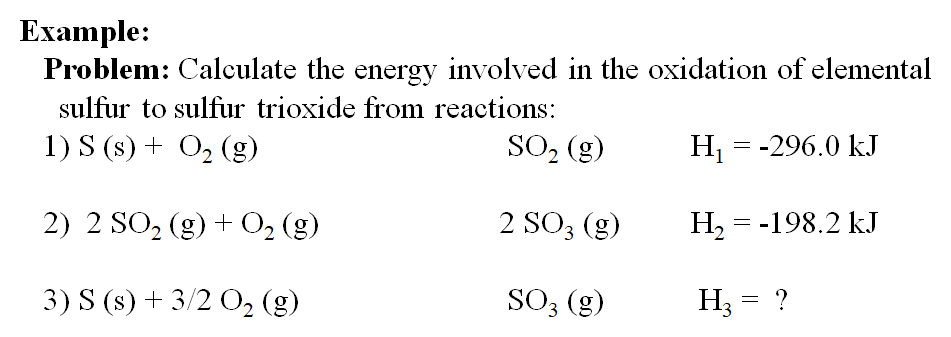
The procedure needed to answer the question above is based on the principle that if you lot add together ii or more equations to go a new equation, you must add the ΔH's to become the ΔH for the new equation.
A couple of rules before we offset:
1) If you multiply an equation by a value to go the number of moles to match the reaction needed, you have to multiply the ΔH past the aforementioned value.
2) If you turn a reaction around to go a molecule on the correct side to lucifer the reaction needed, y'all change the sign of the ΔH value for that reaction.
The "target" reaction is Due south (s) + 3/2 O2 (chiliad) → Sothree (thousand) ΔH = ?
In the two reactions nosotros are given, the Sulfur is located in Equation 1 and is in the right form and so we just copy that equation in as is. The second equation contains the Sulfur Trioxide we demand but in the incorrect amount. Since there are two in the equation we will take to dissever the entire equation by two to get information technology into the correct class remembering to cut the enthalpy value in half too:
S (s) + O2 (g) → And then2 (yard) H1 = -296.0 kJ
1/two(2 Thenii (k) + O2 (thousand) → 2SOiii (thou) H2 = -198.2 kJ)
After division the two equations are ready to be added together. We can cancel anything that appears on both sides of the equation in equal amounts:
S (s) + O2 (thou) →Thenii (g) Hi = -296.0 kJ
And thentwo (thou) +ane/2 O2 (g) → And so3 (one thousand) H2 = -99.1 kJ
Southward (s) + three/2 Oii (k) → Theniii (g) ΔH = -395.1 kJ
Here is a website with lots of practice quizzes on all 3 types of enthalpy calculations: Here
In Conclusion, at this point we have learned three ways to calculate the Heat of a Reaction:
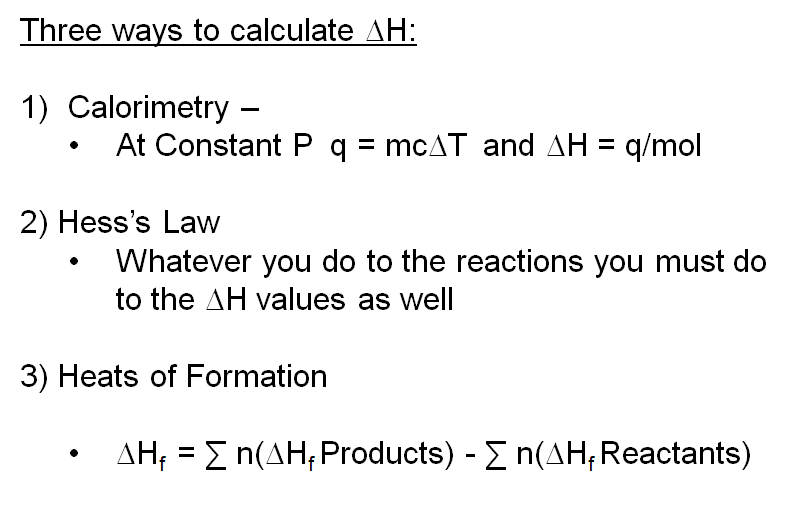
In about a month, once we accept learned how to draw Lewis structures y'all volition learn a 4th method using bond free energy values.

Is Enthalpy Intensive Or Extensive,
Source: https://www.chem.fsu.edu/chemlab/chm1045/enthalpy.html
Posted by: wolfkintil1963.blogspot.com
0 Response to "Is Enthalpy Intensive Or Extensive"
Post a Comment